The first cars
Wind, clockwork, steam and batteries: the cars that came before petrol won.
No single inventor
Unlike many big inventions, the idea of the car can’t be credited to any one person. Encyclopaedia Britannica: History of the automobile
Leonardo da Vinci thought about a self-propelled vehicle in the 15th century. Encyclopaedia Britannica: History of the automobile
Two-masted wind carriages were running in the Netherlands in 1600. One was said to reach 20 miles per hour carrying 28 passengers. Encyclopaedia Britannica: History of the automobile In about 1748 the inventor Jacques de Vaucanson showed a carriage driven by a big clockwork engine in Paris. Encyclopaedia Britannica: History of the automobile
In the 1820s, kite-powered carriages ran between Bristol and London when the wind was right. National Motor Museum: Birth of Motoring In 1807 Isaac de Rivas built a gas-powered vehicle in Paris that ran on hydrogen. Encyclopaedia Britannica: History of the automobile
Cugnot’s steam tractor
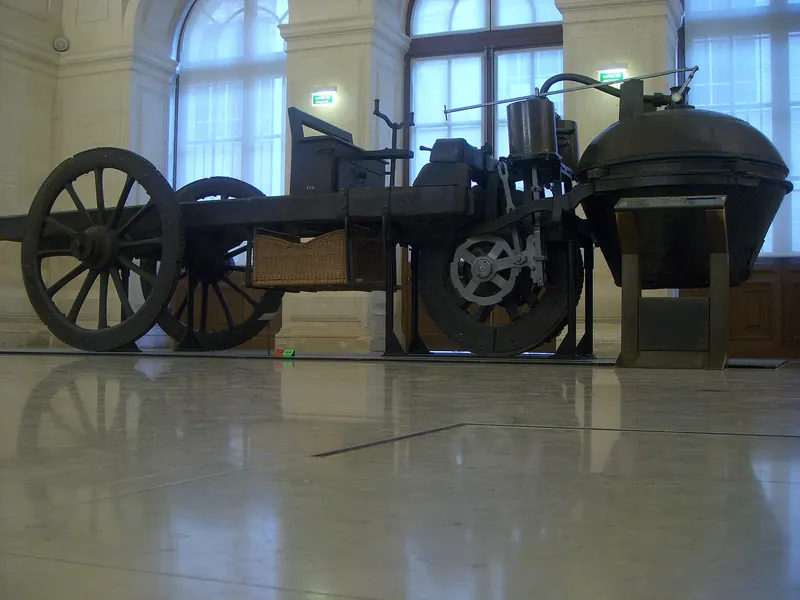
Most historians agree that Nicolas-Joseph Cugnot of France built the first true automobile: a huge, heavy, steam-powered tricycle. Encyclopaedia Britannica: History of the automobile
Cugnot was a French military engineer, and his steam tractors were built to haul artillery: the first in 1769, the second in 1770. Encyclopaedia Britannica: Nicolas-Joseph Cugnot
Cugnot’s 1769 machine was said to run for 20 minutes at 2.25 miles per hour (3.6 km/h), carrying four people. Encyclopaedia Britannica: History of the automobile
Its engine was the first to use high-pressure steam expansively without condensation. Encyclopaedia Britannica: Nicolas-Joseph Cugnot Cugnot’s second vehicle survives in Paris, at the National Conservatory of Arts and Crafts. Encyclopaedia Britannica: Nicolas-Joseph Cugnot
Steam buses were running in Paris by about 1800. Encyclopaedia Britannica: History of the automobile
Steam on British roads
James Watt’s foreman, William Murdock, ran a model steam carriage on the roads of Cornwall in 1784. Encyclopaedia Britannica: History of the automobile
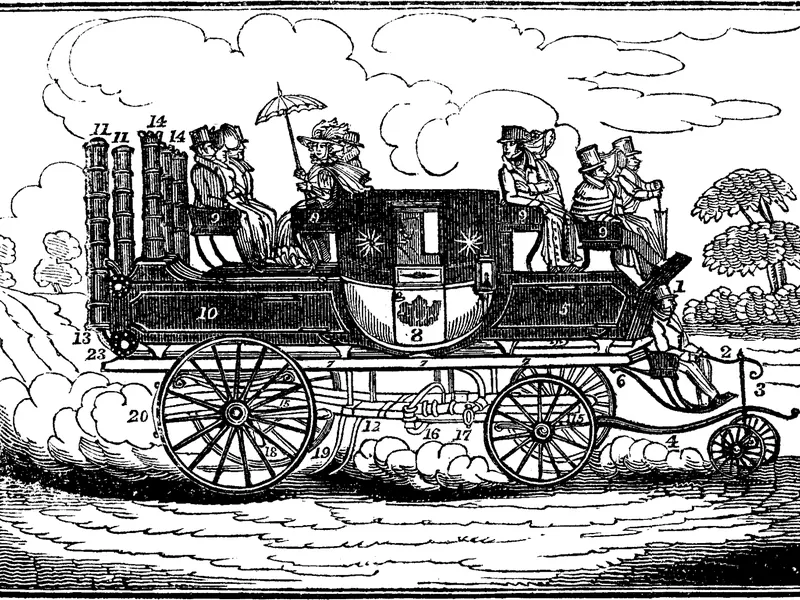
Sir Goldsworthy Gurney was the first commercially successful builder of steam carriages. Encyclopaedia Britannica: History of the automobile Between 27 February and 22 June 1831, steam coaches on the Gloucester to Cheltenham route covered 4,000 miles and carried some 3,000 passengers. Encyclopaedia Britannica: History of the automobile
Horse-coach owners fought back: a steam carriage could be charged £5 at a tollgate that cost a horse coach three pence. Encyclopaedia Britannica: History of the automobile The 1830s were the best years for steam coaches in Britain, but by 1840 it was clear they had little future. Encyclopaedia Britannica: History of the automobile
The law then made things even harder: see the Red Flag Act on the Britain page.
Electric cars came early
Gaston Planté invented the storage battery in 1859–60, and Camille Faure improved it in 1881. Encyclopaedia Britannica: History of the automobile Probably the first electric vehicle, a tricycle, ran in Paris in 1881. Encyclopaedia Britannica: History of the automobile
The first American battery car, built by William Morrison in Des Moines, Iowa, around 1890, could keep up 14 miles per hour. Encyclopaedia Britannica: History of the automobile
Early electric cars were slow (15–20 mph) and had a short range of 30–40 miles. Encyclopaedia Britannica: History of the automobile
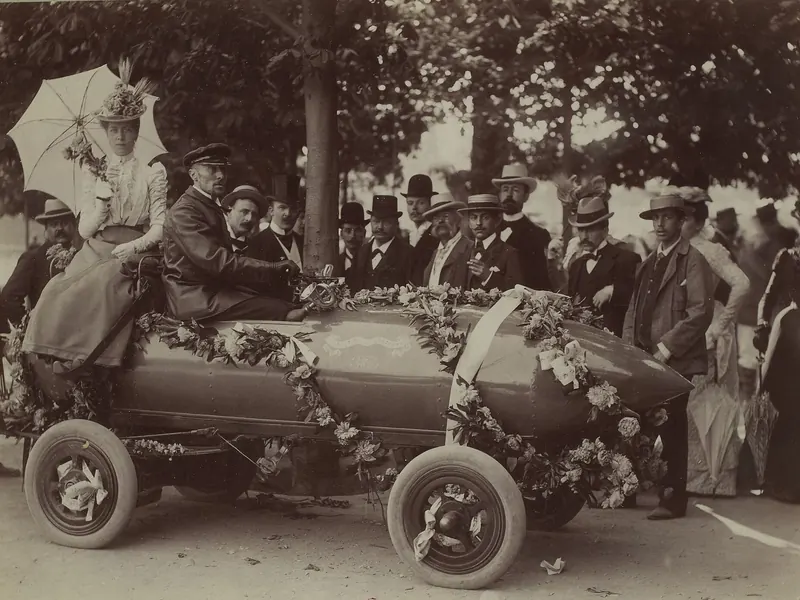
The first car to go faster than 100 km/h (60 mph) was an electric one: Camille Jenatzy’s La Jamais Contente, in 1899. Encyclopaedia Britannica: History of the automobile
In 1898 an electric car of Jenatzy’s easily won a French hill-climb held to test steam, electric and petrol power. Encyclopaedia Britannica: History of the automobile
By 1912 some 20 companies made electric cars, and 33,842 were registered in the United States. Encyclopaedia Britannica: History of the automobile
Steam against electric against petrol
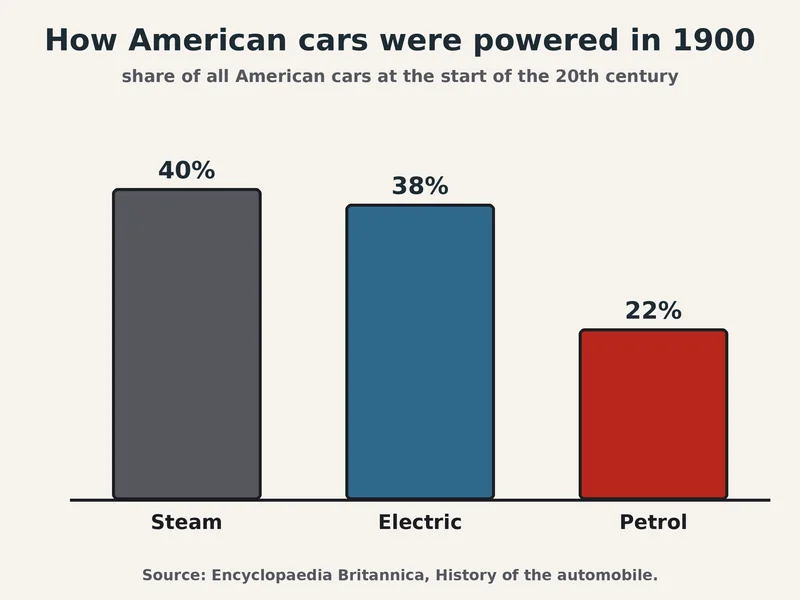
At the start of the 20th century, 40% of American cars ran on steam, 38% on electricity and only 22% on petrol. Encyclopaedia Britannica: History of the automobile
The Stanley design, sold as the Locomobile, was the first commercially successful American-made car. About 1,000 were built in 1900. Encyclopaedia Britannica: History of the automobile
In 1906 a Stanley steam car set the world speed record at 127.66 miles per hour (205.45 km/h). Encyclopaedia Britannica: History of the automobile
The electric self-starter did much to end the electric car, because it got rid of the hand crank on petrol cars. Encyclopaedia Britannica: History of the automobile
By 1910 most makers of steam cars had switched to petrol, though the Stanley brothers kept building steamers until the early 1920s. Encyclopaedia Britannica: Automotive industry
Electric milk floats went on delivering in British towns for the rest of the 20th century. Encyclopaedia Britannica: History of the automobile
Next: Benz and Daimler →